Japan & CITES

In the 1970s and 1980s, elephants were being killed en masse for their tusks. In response to this poaching crisis, international commercial trade in ivory was banned in 1989 under the Convention on International Trade in Endangered Species of Wild Fauna and Flora (CITES). However, most countries maintained domestic ivory markets, permitting commercial trade in ivory domestically even though it was banned internationally.
Unfortunately, the 1989 international ivory ban was seriously weakened by two legal international sales of ivory, the first to Japan (1999) and a second to Japan and China (2008).
These two CITES-approved “one-off sales” of ivory to supply domestic markets invigorated demand, which precipitated another African elephant poaching crisis that peaked in 2011. Japan has played an important role in the history of international ivory trade, as a major consumer and the only country to import ivory for domestic sale after international trade was banned.
In response to the uptick in poaching, in 2016, Parties to CITES agreed by consensus to a resolution that urged all countries with legal markets that contribute to poaching or illegal trade to close them. Most of the world’s ivory consuming countries have closed their markets or closed them with very limited exemptions, including the United States, China, the United Kingdom, European Union, Hong Kong SAR, and Singapore.
However, Japan is an outlier and has chosen to maintain a substantial legal trade in ivory. Instead of working to reduce demand, the Japanese government props up its ivory industry via market regulations which are designed to facilitate trade in ivory products rather than tighten trade restrictions. The Government of Japan consistently asserts that it is “inappropriate” to call for the closure of its ivory market.
Japan’s position on ivory trade, questionable regulatory and enforcement measures, and seizures of ivory from Japan made in other jurisdictions have been in the spotlight for years at CITES meetings. Many African elephant range states have appealed to Japan to close its market to protect their elephant populations. Japan continues to hold its position that its market does not contribute to poaching or illegal trade and thus it is not under obligation to close its domestic market. However, ivory purchased legally in Japan is being illegally exported and seized by authorities in other countries, contributing to the international illegal trade problem.
Japan’s legal ivory market contributes directly to international illegal ivory trade by stimulating demand and supplying ivory for illegal exportation which undermines enforcement in countries with ivory bans in place. Domestic ivory markets perpetuate the consumer demand driving the elephant poaching crisis, and provide a means for organized criminals to launder poached ivory through legal trade.
Choosing to retain a legal ivory market sends a signal of support for maintaining demand and restarting international ivory trade. At CITES meetings, Japan consistently aligns with southern African countries that want to sell their ivory stockpiles instead of many African countries that endorse market closure to best protect their small populations of savanna and forest elephants from poaching.
According to the recent United Nations Office of Drugs and Crime’s (UNODC) World Wildlife Crime report, the closing of key domestic ivory markets has contributed to a combination of interventions that have led to the ivory market shrinking since its peak in 2011.
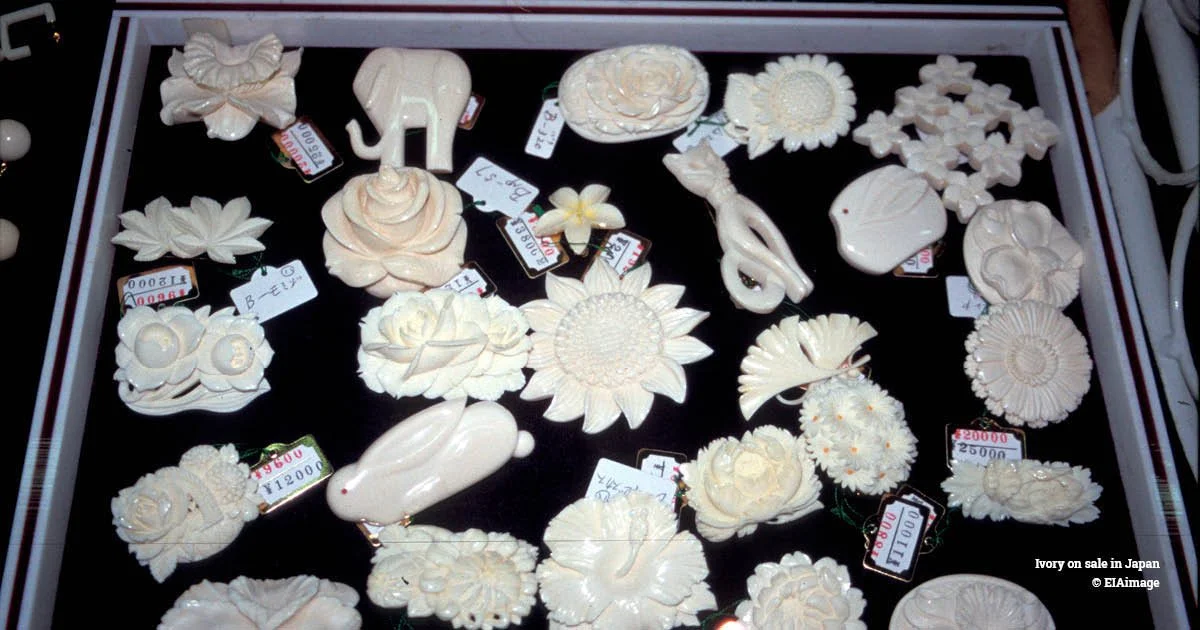
The closure of domestic ivory markets plays a critical role in addressing transnational organized crime by reducing the demand for ivory, disrupting cross border trafficking networks, simplifying enforcement efforts, and strengthening international cooperation to solve a global problem.
To move towards ending the trade in ivory for good in order to protect wild elephants from poaching, Japan must align with other ivory consuming countries and take steps to close its market.
Environmental Investigation Agency US (EIA) is an independent non-profit campaigning organization dedicated to protecting the environment by exposing environmental crime and campaigning for the protection of the natural world via progressive policy-making, improved law enforcement, and behavior change. EIA uses evidence to create positive, lasting change to address the biggest global environmental challenges of our time. For more information visit eia.org

Japan Tiger and Elephant Fund (JTEF) is a certified non-profit and non-governmental organization based in Tokyo, Japan, dedicated to protecting endangered wildlife and conserving global biodiversity. JTEF works to safeguard elephants, tigers, and the critically endangered Iriomote cats through advocacy, education, and on-the-ground conservation. Learn more about JTEF’s work at jtef.jp.
Stop Japan Ivory Trade
EIA and JTEF created this website as a resource hub for policy makers and interested stakeholders. We support and advocate for the closure of all ivory markets globally in order to protect wild elephants into the future.